Wednesday, July 6, 2011

Safer AHMEN Medical Clinics

The patient and family wait patiently and finally see the doctor.  An illness may be diagnosed and appropriate medication is prescribed.  The patient, and her trailing children walk to the AHMEN pharmacy and the doctor’s prescription is filled for the patient.  In addition to the therapeutic medication given, it is likely that the family will be given vitamins for each member and maybe an anti-parasite medication.  We give out lots of vitamins.  I wonder the patients think there is some magical power associated with vitamins?  The kids sure like them though.

So we hand the mother a labeled plastic zip-top baggie full of vitamins for each child.   We carefully admonish the parent and the child about dosage.  “Only one tablet each day!  These are medicine, not candy”.  Off goes the family to their home and we feel good about our successful thwarting of malnutrition. 


Each AHMEN medical mission team spends a lot of money on vitamins.  They are not cheap regardless of the source.  We purchase large quantities for adults, children and pregnant women.  We usually try to buy vitamins containing iron, as most brands do.  Children’s vitamins are almost always tasty morsels, chewy, sweet and shaped like characters that the kids in Honduras have never seen.  What the kids see is a baggie of somewhat sour, but still yummy candy.  More than a few times I have seen a child eating their month or two’s supply of vitamins like it was a bag of M&Ms.  Did we not make it clear enough that this is ”medicine”?  What could we have said differently?  Was our translation of instructions accurate?  Or, are they just kids that like all others and can't resist sweet treats.

Vitamins are not candy.  We adults know that.   In the U.S., they are a mega business catering to both parents and the kids.  Flintstones, Gummies, every Saturday cartoon hero has a “one-a-day” image of themselves sitting on the shelf at Walmart.  Specifically, the problem with vitamins is their iron content.  Iron is toxic when taken to excess.  Difficult to treat in the U.S., severe iron poisoning in Honduras is likely to be lethal to a child.  Vitamins are not the only problem.  What if a child gets hold of some blood pressure medicine or some diabetes medicine?  The odds of a child surviving an overdose of grandma’s diabetes pills are not good.


We hand out thousands of pills in ways that can endanger people on every medical mission trip.  To my knowledge, we have had no medication related problems as a result of an AHMEN mission.  We do hear stories about children dying yearly as a result of American medical mission team.  Urban legend?  More importantly, what can we do about it?  How can we lessen the risk of harming the people we work so hard to help?

In the U.S. there are regulations that pharmacies must adhere to concerning packaging, labeling and patient instructions for every prescription they fill.  I think it is time for us to try to emulate their good points.

The first change I propose is the use of child resistant containers wherever possible.  The plastic bags we use now for medications cast a few cents each.  Using plastic pill bottles with “C/R” caps would cost about 18-50 cents per prescription, depending on the size of the bottle.  The label on each bag/bottle cost another 2-3 cents.  These seem like small amounts, but filling several hundred scripts each day can get expensive.  I anticipate that using safe packaging will add $200-$300 to the cost of medication and supplies for most missions.  The shear volume of the bottles will require extra baggage. 

Those working in the pharmacy must realize that their job is extremely important.  They must fill each prescription accurately and they must be sure that the patient or caregiver completely understands how the medication is to be taken.  The pharmacy is the busiest place at the clinic.  It is the place where bottlenecks occur and where mistakes are most likely to occur.  We must spend extra time training those serving amidst the hundreds of containers of pills.  There must be no language barriers in the pharmacy.

AHMEN will be sending a team to Honduras in August.  Child resistant packaging will be ordered for the clinics this week in hopes that our effort will make our medical mission work as safe as it is effective.  


Friday, June 3, 2011

Honduras: My Future in My First Centimeters

I received this link from Project Honduras.  It is a World Bank production on YouTube.com.  Granted, I am not a great fan of the World Bank but the video was interesting.  The apparent goal of the video, is to describe a simple way to measure the nutritional health of children.  World wide, a child should be about 80 cm tall by the time they are two years old. This number is independent of where in the world the child lives  Less than that is an indicator of poor nutrition.  It is a simple way for the parents and health care providers to know the progress of their growing children.  The video is in both Spanish and English, and is directly directed at a Honduran audience.

My thoughts were to put this video on a CD and run it in the waiting area for your next clinic in Honduras.  Most teams bring a laptop with us.  What better way to fill the waiting time to see the doctor than to teach.  

Watch the video.  If you know how to download and capture a YouTube, video than do so and bring it with you on your next mission.  If you can't do this, email me telling me the video format you need and I will mail you a copy on a CD or DVD.


Links In English and Spanish :


Wednesday, May 18, 2011

The Path of the Monster of Spring

Today, I hand a chance to drive to the airport in Jasper and take my airplane up to fly around for a while.  Even a few weeks away from the cockpit weighs heavy on your nerves.  As I push in the throttle, and speed to take off, my mind rechecks all the things I must be sure to do right then.  The air is smooth and the very slight chill gives the propeller a little extra bite.  The climb out is brisk and invigorating.  It all falls together.  I am comfortable at the controls, flying with my brainstem, coordinating the controls like my flight instructor required so many years ago.  I had nowhere special to go today.  A plane not flown regularly becomes old quickly, it needs regular exercise, as does the pilot.

On April 27, 2011, the Dread of Spring visited Alabama.  A cold front crossed the State spawning super cells and tornados.   I was in Honduras at the time, out of touch with the rest of the world.  I'd not spoken to Alison in two days.   I called her on the morning of the 28th, totally unaware of the events of the previous day.  "There were big storms yesterday" she said.  Her voice was broken and I feared the worst for our home and family.  She assured me that everything was fine at our home and that the kids and grandkids were OK.  I breathed a little easier, but there was still some doubt in my mind.  My gentle wife was not above a white lie to protect me, 1500 miles from home.

The storms had been catastrophic for many areas of the State.  Many were killed and million of dollars of damage done by a twisting monster of wind traveled across the hills and woods of Alabama decimating large and small towns.  Tuscaloosa, Cordova, Cullman, Arab and many other barely wide spots in the road were beaten and ripped beyond recognition leaving a path almost 200 miles long.  A scar upon the land that will be evident for decades.

I flew the short distance to Cordova out of morbid curiosity.  More than two weeks after the storms, there has been a lot of clean up.  There was no mistaking the damage.  Even from 3500 feet above, it was easy to see the wreckage.  Piles of junk that were once home, forests flattened, and the path of the tornado clearly evident over the low hills.

I followed the trail to the north for several miles.  I marveled at the straightness of the path, barely wavering as if with a destination or purpose in mind.  It destroyed everything in its path, except a few places where it seemed to jump over a small home or patch of forest.  There was no rhyme or reason.   I turned and headed toward Tuscaloosa, some sixty mile southwest, across the valley of the Black Warrior River,  I followed the path of the storm as it had gouged it's way through woods, over coal mines, ponds and farms.  Trees, like scrambled matchsticks, land scraped to bedrock, piles of former homes and some lucky blue tarp covered homes along the way.  I could see the city of Tuscaloosa in the distance.  The brownish gouge in the land leading the way directly to it.  I'd seen enough.  I turned back toward Jasper to land.

After I spoke to Alison the morning after the storms, here voice seemed to hide something.  Was there tragedy in our life that she could not bear to tell me?  I wasn't sure until I was home over a week later and saw for myself that all was well.

Who can portend to understand the random violence of the storm monster, nor the reasons for it?  

The tornado path into the distance.

Friday, May 13, 2011

AHMEN/CHIMES Medical Mission to Honduras: Part 3

This is the third installment in a series of entries detailing the recent AHMEN/CHIMES Medical Mission to La Moskitia, Gracias a Dios, Honduras.  April 25-May 7, 2011.  

The Rio Plátano at Las Marias
Day 8: (continued) We left Las Marias early in the morning.  There was indeed more water in the river after the rain the night before, but not as much as we hoped for.  We still had to get out of the canoe several times to negotiate the shoals.  Clouds began to build and darken.  Soon we were in a tropical downpour.  The river curved and twisted dramatically and at times we passed from beneath the seemingly saturated clouds only to have the rain start again at the next turn.  Soon, there were a few inches of water in the bottom of the canoe.  We all noticed a change in the stability of the canoe.  Now, a little gentle rock was exaggerated when the water in the bottom of the boat shifted when the canoe changed direction.  Although we never shipped water, it got within a few inches of the gunwale.  Finally the driver beached the canoe to bail it out.   A small plastic bowl and an old sponge were all he had to use.    At least the rain had finally stopped.  The ride was better and we made good time to the mouth of the river and the canal to Ibans lagoon.  Even in the downpour, Moskito women still washed clothes in the river and the children were still swimming.  Rain in the rain forest is just rain.  It rarely changes the routine and you'll dry out as soon as the sun comes out.  If the roof is leaking now, it's too wet to fix it.  If it isn't raining, it doesn't leak.  

The rain and windswept beach at Raista  (T.Arnold photo)
We passed through the canal into Ibans lagoon.  We were back within cell phone range and several of us called home.  In a short time we reached the village of Raista.  This is a Moskito village right on the ocean and the lagoon.  A long barrier island, about 400 yards in depth separates the two bodies of water.  There are mangrove trees on the fresh water lagoon side and a wide dune-guarded ocean beach on the other.  


Doña Elma's hotel in Raista
We will stay at Doña Elma's hotel right on the lagoon.  There are several building there.  A large hotel building with about ten rooms and a smaller hotel building with perhaps three or four more rooms.  She can sleep about twenty people or so.  There are showers, toilets and sinks with running water.   Each room has a veranda with a hammock.  There are meeting rooms and a large kitchen and dining room.  The dining room has a sand floor, repeatedly swept clean and smooth by the staff.  There are two big tables where we can all eat together and a palm thatched roof above.  All the rooms except the kitchen were on stilts.  The rooms are comfortable, with mosquito nets on every bed.  


Cashew fruit (T. Arnold photo)
There are large cashew trees scattered about the grounds.  Folks there eat the soft fruit of the cashew tree.  The fruit looked like a bright yellow bell pepper with the hard cashew-shaped nut attached at the bottom.  Sweet and very juicy, the fruit was tasty.  Children used bamboo poles to knock the fruit down to eat.  We were served cashew juice at breakfast.

Heavy rain on a thatched roof in Raista
Doña Elma is known for her cooking and her hospitality.  We had fresh shrimp and fish at several meals, along with chicken, pork chops, fresh tomatoes, and fruit.  And of course, the obligatory tortillas and frijoles.  When the economy was better, so was her business.  She was glad to see a group as large as ours.  We asked if there was someone who could do a little laundry for us.  It was done gratis because we were medical volunteers.  Raista is a fairly large village.  There is even an airstrip there as well as several small stores and churches.  We planned a clinic there in the morning.  It rained heavily all that night.  The thatched roofs leaked a little, but not too much.  No one seemed to mind.  The rain lasted all the next day.  We were just glad we were not in the canoes.  

Eduardo works in the pharmacy
Day 9:  We held our clinic under the hotel and in Doña Elma's home.  We saw almost 200 patients that day.  That night at supper, in walked two English speaking women, one an American and one from Australia.  They were traveling to Las Marias.  This place seemed to be the crossroads of La Moskitia.  

Moskito children are not uncommonly fair-haired
We decided to hold a second clinic day in Raista.  We were running low on medications and we were drawing people from as far as Ibans village and New Jerusalem several miles away.  We saw quite a number of patients, but not nearly as many as the previous day.  There were a few rain showers, but it was a nice place to be.  Another Frisbee was introduced to the local kids and soon it was sailing all over the compound.  Kids are kids, wherever they live.

Healthy children smile from deep inside

Too shy for a smile

Sisters in Raista
Day 10:  The next morning we said goodbye to Eduardo and Stephanie and loaded the canoes to return to Palacios.  We could see thick rain clouds piled heavily over the mountains across the lagoon near Las Marias, but the weather on the north side of the lagoon was pleasant.  We saw a few children seining the vegetation in the lake for freshwater shrimp, tiny, but easy to collect.  After a few miles along the shore and we pass into the river, the main thoroughfare along the coast.  In a couple of places the river spills into the Caribbean Sea.  Breakers are visible low against the sky, openings in wall of trees.  We pass by a sandbar where a small crocodile lays in the sun.  A frigate bird circles in concert with a buzzard, completely different in grace and style but sharing the sky to trace large, lazy circles above the jungle.  


We pass through the narrow cut-off river into the lagoon at Palacios and check in at the Naval Station.  The bored young Honduran Marine nods and shifts his American rifle as we pass by.  The La Moskitia Hotel is a mile ahead.  We dock and unload the boat and relax for a while before dinner. 

The road home
Day 11:  The next morning we will reload the boats and cross the river to Pueblo Nuevo, and pack the trucks to make the long drive to La Ceiba.  The trip along the beach should be easy.  There has been some rain.  Not enough to swell the four rivers along the way and require crossing by balsas, but enough to make the sand a little harder and drivable.  The beach road is easy and fun today.  We watch trains of pelicans cruising the waves on a hunt.  We stop at the “drum maker’s” home in Sangrelaya where we shop for a few authentic Garifuna items.  Ceremonial drums, ship models and the like.  We drive on along the beach and cross the river at Iriona easily.

We drop off all the leftover medicine at the hospital at Ciriboya and stop at Mirna’s home for a quick light meal, the best fritas and coffee on the north coast of Honduras.  Two trucks head for La Ceiba, Bud has to drop off some stuff back in Iriona and he’ll catch up with us by Bonito Oriental.   About twenty minutes later we get a call that Bud’s truck has broken down east of Ciriboya.  What next?!!.  We return to Ciriboya to find him stopped at the roadside.  His engine just stopped and won’t start again.  A local mechanic stops to help and quickly discovers that the timing belt has broken, and one of the rocker arms has fractured.  The truck is useless to us and we are eight or ten hours from La Ceiba.  After yet another call to AVIS  another truck is dispatched in our direction, and another long delay begins.  We tow the dead truck to the hospital where Bud, Shack, and Mario will wait for the new truck as the rest of the team drives on to La Ceiba stuffed into the trucks like cordwood.  Norman Coto rides on top of the load in the back of the truck, his I-Pod plugged into his ears and his face covered by a bandana against the dusty roads.   Another breakdown, and another delay that will force us to travel at night in Honduras. 

Drivers in Honduras play by different rules.  Passing each other is at least a popular as futból and played with far less referees.  The shoulders of the roads are filled with horses and cows, pedestrians and bicycles.  America may have invented potholes, but they were perfected in Honduras.  They are also fond of placing speed bumps in the middle of nowhere.  The combination of all this made for an interesting trip.  Finally we arrived at our hotel, again on the Cangrejal River near where we stayed on our first night in La Ceiba. 

View from the hotel above the Rio Cadrejal in La Ceiba
Located on a steep mountainside, seeing where the rooms were located gave us a shock.  We could see the building in the dark, and the seemingly endless flight of stairs leading up to them.   We opted to eat before the assent and enjoyed a nice meal in the comfortable dining hall.  We recruited help with the baggage and soon we were all asleep.  The third truck arrived later that evening and we were all safely together again. 

Tiny wild orchid at Lancetilla
Day 12:  Again we loaded the trucks for the trip to El Progresso and the Casa Blanca Hotel.  We stopped at the Cruzadas compound to drop off some gear that could stay until our next trip.  The Spring container was due in a couple of days and the Bodega had been cleaned and organized.  We talked briefly with Sister Eleanor and Sandy and then we headed west.  We stopped at the Lancetilla Botanical Garden in Tela and spent an hour or two with a guide looking around the beautiful grounds.  We checked into our rooms at Casa Blanca and enjoyed our first warm showers in over a week.  Simple pleasures!  Delmer Montoya, our young Honduran doctor, is from El Progresso and had invited our team to dinner at his family home.  His mother had prepared Paella, a traditional Spanish seafood dish loaded with shrimp, oysters, fish and meat with rice and peas.  We ate in the courtyard of their home and got to know Delmer’s parents.  They are very proud of their son, as well they should be.  Delmer has become an active member of the AHMEN medical teams this year.  Ben Coplan danced with Delmer’s mother while those of us not so musically gifted learned about the palm oil business from Delmer’s father. 

Day 13:  We pack again and drive to the airport in San Pedro Sula.  We board our plane and arrive in Houston after a smooth flight.   After goodbyes, the team scatters to other flights to other cities, where the memories of this mission will fall into their rightful places in time.


Members of the AHMEN/CHIMES La Moskitia team April/May 2011


Monday, May 9, 2011

AHMEN/CHIMES Medical Mission to Honduras: Part 2

Moskito Indians at riverside
Second in a series of entries dealing with the recent AHMEN/CHIMES Medical Mission to La Moskitia, Gracias a Dios, Honduras.  April 25-May 7, 2011

Day 4.  The new truck is on the way to Pueblo Nuevo, and we are all ready for our first medical clinic.  We will travel up the Rio Tinto Negro about two hours to the village of Limonales.  The river is as wide as 250 yards in places and winding slowly through coastal jungle where the riverbank is lined with banana trees and dotted with Miskito indian homes.  The water is low right now, and the 40 foot canoe occasionally scrapes bottom.  Miskito women stand waist deep washing clothes as children swim near them.  Many children wave back as the strangers pass by their traditional thatched platform homes.  There is some traffic on the river today.  Small dugout canoes loaded with plantains, sand or people pass by.  Their canoes sit so deeply in the water that you wonder why any onboard movement doesn't swamp it.  In some, people stand to pole the boats, a testimonial to their balance and experience.  There are large critters in this river.  I've seen porpoises,  I've been told there are sharks as well as the usual crocodiles (caiman).  Water birds fly away as we approach and vultures make their lazy rounds.  Graceful frigate birds glide forever with no apparent effort and the scolding bright yellow King birds are seen frequently.

Limonales clinic.  Brent Brady, Tom Arnold and Delmer Montoya
We arrive in Limonales and set up our clinic in the school building.  Unannounced, it takes about an hour for word to spread that there is a medical brigade in the village.  It takes that long to set up the pharmacy and to set up examination areas for the doctors.  Each patient is registered and their vital signs taken.  They may also have a screening blood sugar done.  We have four physicians with us so patients are seen quickly.  Prescriptions are filled from our well stocked pharmacy and careful patient instructions are given in Spanish by Doris and Eduardo.  Mario and Stephanie maintain crowd control.  Antonio does a few massages.  We see well over 100 people in a couple of hours.  
Wes Wallace speaks with a patient in Limonales
Most patients are treated for parasites and request vitamins.  There are a few rather sick patients including one child born on the day of our first AHMEN clinic in Limonales.  The child has hydrocephalus and many other problem.  Severely disabled, he now has started to have seizures and has a fever.  We do what we can for this pitiful situation.  We eat lunch on the fly and plan to be back in the boat by 3:30.  Travel on the river is not safe at night.  Limonales has changed is the past six months.  There is some public building construction and there is even a pickup truck in town.   How they got it there would be an interesting story in itself.  With increased prosperity comes the plague of civilization, there is plastic trash all over.  There are satellite dishes attached to some of the tiny homes.  An unmarked Cobra helicopter flies low and fast along the river.  This is my fourth time to Limonales and I've seen many changes in two years, not all for the better.  Six months ago, there was a Cuban doctor stationed there.  Cuts by Cuba has pulled most of the physician staffing from Honduras.  There is a public health nurse there, but she has minimal supplies.  The nearest doctor is in Palacios two hours away.  Life goes on.

We travel back to Palacios to find that the three other members of our team are back.  At full strength, we will set out for Las Marias early the next morning.  We will travel as light as possible, taking only what is necessary in addition to our medications.  The Rio Plátano is low and there has been little rain.  We eat dinner at the hotel and ready for the morning.  We are all tired.  

Canal from Ibans lagoon to the Rio Plátano
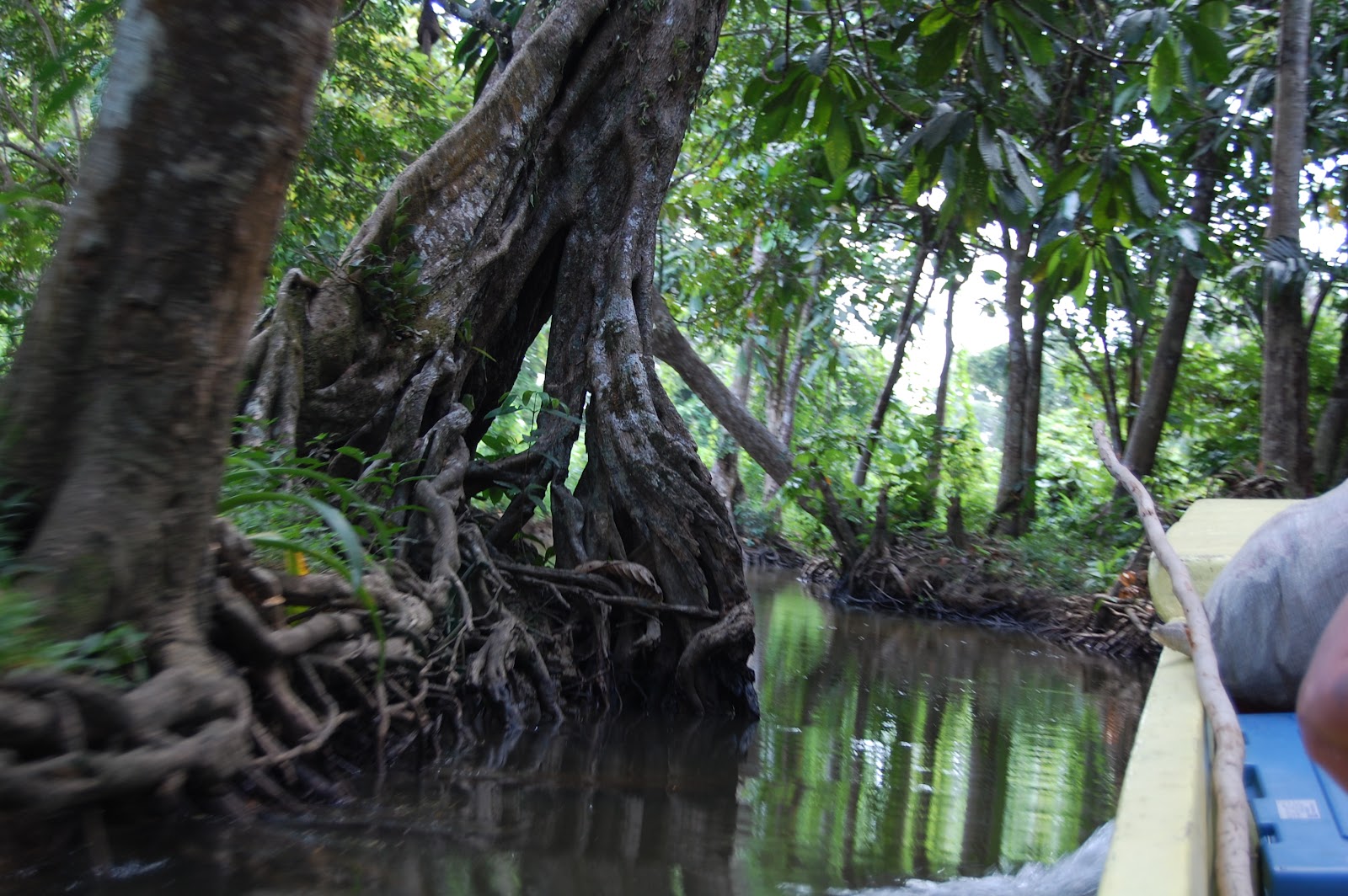
Day 5:  The next morning we are late setting off in our two large canoes.  Sometimes I wonder why we even bother to set a departure time.  One on the canoes was 90 minutes late and then the driver needed to stop for 30 minutes along the way..... whatever!  Finally, we reached and traversed Ibans lagoon, and entered the canal that accesses the Rio Plátano.  The canal is through a dense coastal mangrove swamp looking like a scene out of The African Queen.  We finally reach the the river and we turn upstream.  Dense jungle line the banks.  About 150 feet wide, there are huge trees along the way and many even larger logs lay in the river from previous floods.  The small engine hums and causes a little breeze.  We lather ourselves with sunblock and watch the sky for birds, and the banks for crocs.  The river goes on and on.

Moskito family home for eleven children
We stop on a sandy bank for a pit stop.  There is a modest Miskito home there and we spend a brief time with them.  We buy some roasted corn and meet the family.  The are eleven children and the parents.    The mother is 33 years old.  Their home consists of raised platform of split bamboo covered by a thatched roof.  No walls.  The eldest child is about 10 or 12 years old.  The children are polite but shy.   They all like seeing themselves on a camera display.  There was not an X-box within a hundred miles.
Further upstream, the river becomes narrower and shallower.  Exo, the young man riding the bow, directs the pilot away from hidden logs and rocks.... most of the time.  The frequents heavy rains caused great trees to choke the river and in
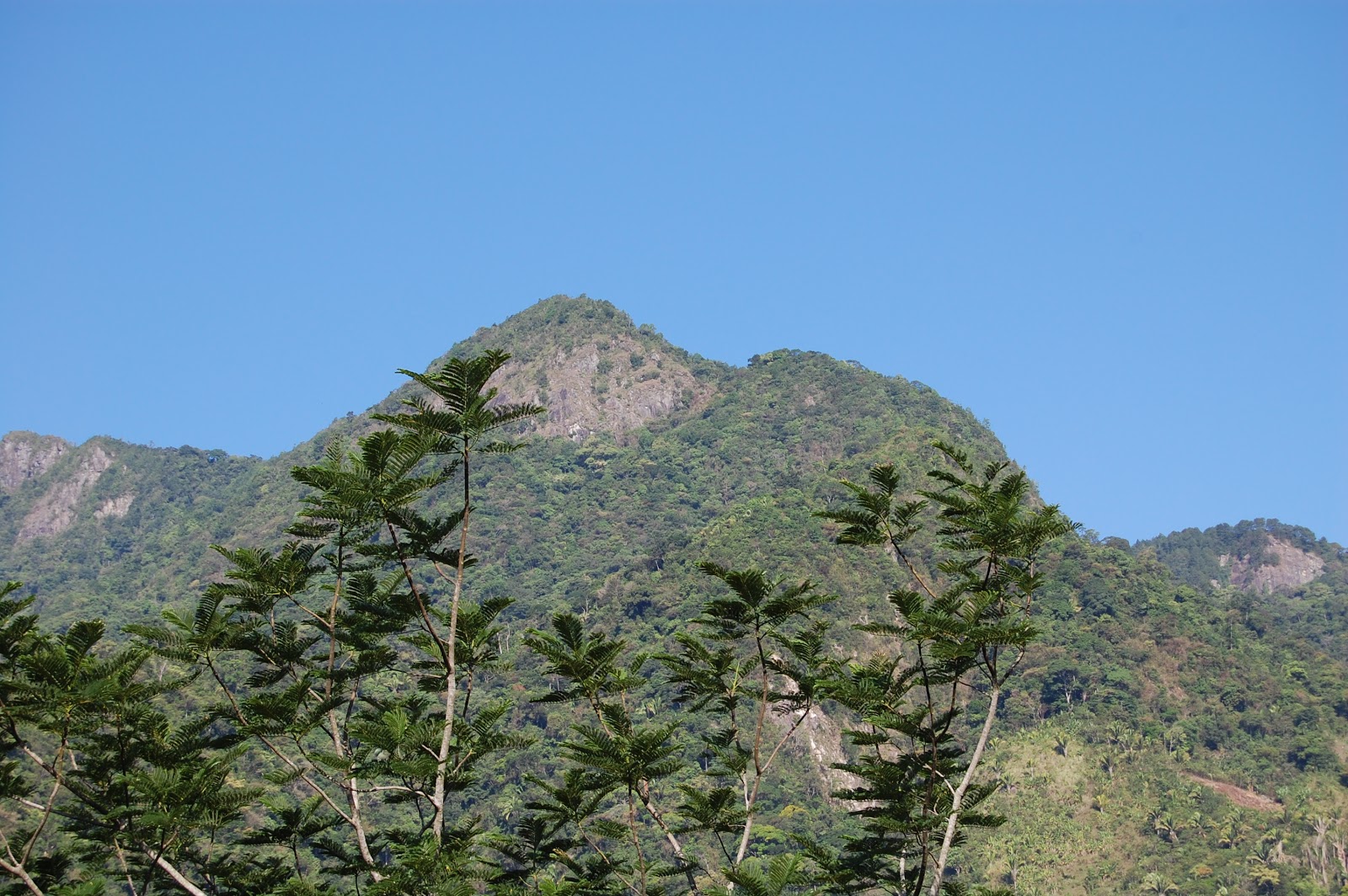
Pico de Damas at sunset 
places.  We must wind our way through a maze of logs and stumps.  Occasionally we run aground and we must exit the  boat to pull and push the boat into to deeper water..  The footing is uneven and we laugh as each of us takes a turn getting wetter than we wanted to.  The shallow spots became more frequent and the current more strong.  Dragging the boat upriver became extremely difficult and dangerous.  At one point, one of the team became so tired that they were unable to stand against the current and was a real danger of being swept away.  It was rapidly getting dark and we could the silhouette of Pico de Damas mountain in the distance.  This is where we were going.  The driver kept telling us we were almost there for what seemed like an eternity.  Every time we ran into another shoal we would have to exit the boat and pull and push it across the rocks hoping not to fall and be seriously injured.  At hard dusk, we finally arrived in Las Marias with arms and legs intact.  

Hotel at Las Marias
Las Marias is the last village on the river that can be accessed by motorized boat.  Beyond here, the river can only be traveled in a pitante poled by indian boatmen.  Las Marias is a Miskito village.  Beyond here, the reclusive Pech indians live mostly as they have done for generation.  This is true rain forest.  Huge unfamiliar trees laden with orchids and bromeliads are everywhere.  Birds squawk their vespers in a thousand voices.   The hotel is ready for us with its five rooms.  There is another lodge a brief walk down a path where some of us will sleep.  There is a generator for a couple of lightbulbs, but candles are the only light in the rooms.  Each bed had a mosquito net and some even have no holes.  The building sits on stilts, and pigs, chickens and even larger farm animal run beneath it.  A tipico dinner was served and we all went to bed exhausted.  The morning will bring the first of two clinic days.

Pat and Sug doing what nurses do best.
Day 6: Breakfast of eggs, frijoles, fritas and strong Honduran coffee greets us as we plan for the day.  We carry our supplies to the local school and set up.  Miskito indians are handsome people, and the children are especially so.  Freshly scrubbed and on their best behavior, the kids were all cheerful and brave, even when they received an injection.  A frisbee gave hours of fun near the school and an air pump brought the local  pelota de futbal to life.  We treated almost 170 people on the first day of clinic.  There were a few cases of malaria, and lots of parasites.  We also treated diarrhea and skin infection and the usual gripe.  There was not as much hypertension and diabetes as among the Garifuna.  On the second day a one month old child was brought to see us, febrile and extremely dehydrated.  The child needed IV fluids if it was to survive.   An external jugular vein line was placed by Wes Wallace and the child was quickly rehydrated.  We suspected an abscessed neck because of the local swelling.  Large doses of antibiotics were given and plans were made to see the child again in the morning.  The mother was carefully taught what needed to be done to keep the child alive.  We hoped she understood.  There is a public health nurse in Las Marias.  We spoke with her about the sick baby and made arrangements to continue therapy.  We may never know what becomes of this child.  Moskito families do not name their children at birth, a tradition born out of the high infant mortality in the area.  On the second clinic days we saw a few Pech indians.  More oriental in appearance with straighter hair and higher cheek bones than the Miskito, they live far away from the village in the forest. They are shy and rarely come to town except at night.  In fact, we innocently asked a local if they were Moskito or Pech before we knew, and they all started laughing about our ignorance  Apparently there are social strata even among the residents of the rain forest.  There are much less that 2000 Pech left as their identity slips into history. 

Dr. Ben Coplan and Brent Brady await their next patient.
Photo by T. Arnold
We had never held a two day clinic in Las Marias.  This village is so remote that no doctors ever come here.  We were not sure how many patients we would see.  On the second day we saw about 50 including our sickest patient.  We had time to rest and explore the area after we closed.

Las Marias is a village out of the past.  There are no cars or motorcycles.  There are a few generators but the cost of fuel here precludes all but special use.  People grow what they eat.  We were served fresh fish and a little pork, even some deer killed in the forest.

Although off the beaten track, there were other guests at the hotel.  Two young men from Germany and a young woman from England stopped here to climb Pico de Damas.  They had been traveling for months through Central America.  Their destinations were Nicaragua and Brazil.  Oh, to be that young and free again!

Day 8:  The sick child from the day before was brought to the hotel looking as good as we hoped for.  Another injection and careful instructions to the mother and town nurse were given again.  The local pastor prayed for the child and we all wondered about its future.  We climbed back into the canoes for the trip downriver to Raista located on the shore of Ibans lagoon.  It rained last night heavily and we were hoping there is more water in the river.  The current will speed our way.  The trip was indeed faster and there was a bit more water, but we still had to drag the boat in a few places, but it was easier.  Next stop: Raista. 

Parrots always fly in pairs

Moravian Church in Las Marias founded in 1936
Our team takes a break on the way down river