Sunday, December 18, 2011

Foul Dealings With a Special Fowl


In October, I attended a meeting held at the Honduran consulate in Atlanta.  Hosted by the Consul, Sra. Emelisa Callejas, the attendees were addressed by various representatives of the Honduran government.  Officials came from Honduras, from the Embassy in Washington, DC, and from Atlanta.  There were about one hundred members of American NGOs and charitable organizations present.  All of us had paid for a chance to meet with representatives of the government of the people we are committed to help. 

We heard presentations by several departments of the Honduran government, ranging from dealing with import duties, long-range national planning goals, and security, to Customs.   We had the opportunity to individually discuss specific problems with the Consul, her staff and the other officials.

The one constant theme of the meeting was just how much the government appreciates the efforts of the NGOs.  The officials made specials effort to try to make it easier for groups such as ours to have effective communication with the government.  They acknowledged the important role that charitable groups play in Honduras, especially in providing medical care to the poor.  Recent emails from the Consulate tell of a new office opening in Atlanta for the expressed purpose of assisting NGOs working in Honduras.   Things are beginning to look as if the Honduran government realizes how much we do for their people, and they are even trying to show they appreciate the assistance.  This may be the case with the Atlanta Consulate, but meanwhile, back in Tegucigalpa they seem to have a different view. 

Most of us have waited in the long queue at the airport in San Pedro Sula to pay the $37 exit tax.  Despite paying large amount out of our own pocket for the chance to serve the people of Honduras, we are told to pay more money just leave the country.  The members of the Honduran government recently voted to increase the exit tax to $60 per person.  Now, besides having one of the highest murder rates in the world, they also have one of the highest exit taxes.  It’s good to see progress.

The tourist trade in Honduras is, let’s say, not flourishing.   The business climate is less than safe and friendly for foreign concerns.  The average Honduran doesn’t vacation abroad.  Who then, is the airport exit tax aimed at?  In my opinion it is at least partially aimed at the thousands of missioners and relief workers traveling to Honduras yearly.   The total amount of exit tax monies they receive now must be huge, considering that the government counts over 1200 NGOs working in Honduras.  Soon there will be a 60% increase in the amount you will have to pay to leave by plane, perhaps as soon as January.  (We wouldn't want to miss the beginning of mission season.)

What long term effects will this have?  Will this be the straw that breaks the camels back for many individuals, or mission teams, or even whole organizations?   What effect will it have on the people we serve?  How many people will not get our services because of this action?  What about hotels, restaurants, truck rentals and just about everything groups such as ours uses in Honduras.  Bluntly, this decision by the National Congress is shortsighted, greedy and shows a distinct lack of appreciation for the work done by NGOs in Honduras.   I hope they haven’t started to kill the goose that lays the golden eggs.

Tuesday, November 8, 2011

NGOs Meet with the Honduran Consul General in Atlanta


I attended the gathering of NGOs working in Honduras held at the Honduran Consulate in Atlanta last week.  It was held in the Latin American Center on Buford Highway; a modern building which houses the consulates of several Central American countries.  The meeting was quite good, in reality.  There  were well over 100 people there, and more than 30 NGOs represented.  The Consul General from Atlanta is an impressive lady.  Down to earth and clearly wants to be helpful to the NGOs helping Honduras  She greeted EVERY attendee personally at their tables with a brief chat and handshake.   There were a few people I knew there, but most were new to the Guffeys, Lou and I.  All but one of the speakers were Hondurans involved with the government.  The flavor of the gringos' attitude quickly became evident with very pointed questions about filling out tariff forms for donations.  I felt a little sorry for the poor young woman who possibly had no idea how complex the government forms really are and how long it takes the gov't to respond to queries, and the complete lack of effective assistance to NGOs.  Stories of MONTHS of waiting for signatures on required forms and months of waiting for Customs clearance received nods of agreement and frequent applause. 


Some who attended the conference at the Consulate

No one was rude, but it was obvious that all the folks attending were less than pleased with the lack of support by the Gov't for people that are doing work in Honduras that the gov't is clearly not able to do.  The first speaker gave many straight answers to specific question.  WHO can sign these forms? What is YOUR number and extension?  In your absence just WHO can sign the forms.  How long should the process take?  (she guaranteed a total of 5 days and to call HER if it takes longer).  

The second speaker was from the Nat'l Police discussing the security situation in Honduras.  The speaker was very high in the police hierarchy but I don't remember his name or rank.  Their opinion is clearly that the current violence in Honduras is almost all drug related, and because 90% of the drugs end up in the US, we Americans have a major responsibility for it.  (agreed!!!).  He contends that within two weeks, there would be major events and changes.  MY gut is that the US will be playing a more active supporting role.  He promised that the country would quickly respond to "199" calls from missioners, (like 911 here), and that all the police would be more attentive to mission groups.  We were advised to contact the Consulate with itineraries for each mission so that they can inform the National Police to watch out for us.  We were also advised to inform the US Embassy of our presence in HN.  

The Consul promised to make herself and her staff more accessible to NGOs.  She promised a dedicated phone line for NGOs at the consulate.  After the short first day, apparently the speakers were in touch with the Government of Honduras and their Embassy in DC.  I surmise that they realized how frustrated the NGOs are in dealing with the HN Gov't bureaucracy.    Every speaker indicated their appreciation and the importance of the work we do.  They understand that we may be the only source of help for a major portion of the country.  They all repeatedly promised to be helpful and accessible.  

On the second day of the conference there were speakers from several secretariats of the Gov't including women's rights, taxes, national planning, the new welfare program for the ultra poor, etc.  Of note was the absence of any official from the HN Customs office.  They however told us to contact the Honduran Embassy and Consulate if we get the run-around in dealing with our container. AHMEN was not the only NGO tormented by Customs red tape in HN.  

This was the first time that an event like this had been held and there were rough spots, like no written agendas for attendees, no list of the speakers and their contact info, and translation services that were not nearly as good at Copan.  But, as I said, this was the first time that the Honduran Gov't had attempted anything of this sort.  I fully expect that this type of thing will be held again, and possibly at other consulates in the US.  

Last night, I talked with Marco Cáceres from Project Honduras about the Atlanta meeting.  His opinion is less than optimistic about changes.  He has heard the promises before.  

One thing certain is that the Atlanta Consulate is now fully aware that NGOs working for Honduras are unified in their expectations of action by the government.  One NGO member even said that he had been told by another Central American country that they promised NGOs would never be taxed or hindered in their country.  Essentially would give red carpet treatment to NGOs if they will come to their country instead of HN.  This was a concerning thing to the Consul.  The NGOs are universally tired of the way things have become in HN and they want to be treated better considering what they do.  Not that they are demanding special treatment, but simply assistance in negotiating the maze of red tape and molasses-like bureaucracy.  The theme of the NGO questions seemed to be "why is Honduras making it so hard for us to help you?"


We were repeatedly told that there was to be a meeting in Tegucigalpa on Tuesday to discuss the Atlanta meeting.  The President of Honduras is scheduled to be there as well as members of Congress and Ministers from various departments of the government.  I will certainly be watching my email for the promised notifications and improvements in policy, in hopes that this conference was more than just lip service.
I will certainly attend next year, or whenever it is held again.  I intend to suggest that similar events be held at the other Consulates of which there are 6 or 8 in the US.

It was an extremely worthwhile event, both for NGOs and the HN Gov't.  I'm sure that Guffy will also have something to say about the meeting also.

Wednesday, October 12, 2011

Conference On Honduras 2011


I attended the three-day Conference on Honduras held at Copán Ruinas last week.  Those attending from AHMEN also included Tom Camp, Michael Franklin, Doris and Brent Brady and Byron Morales.  Although I had been in Honduras quite a few times over the past several years, this was the first time I had the opportunity to meet so many people working for the betterment of the people of Honduras.  I have been in the town of Copán Ruinas before, but never long enough to really enjoy what this town has to offer.  I was truly impressed.

Mayan Ball Field
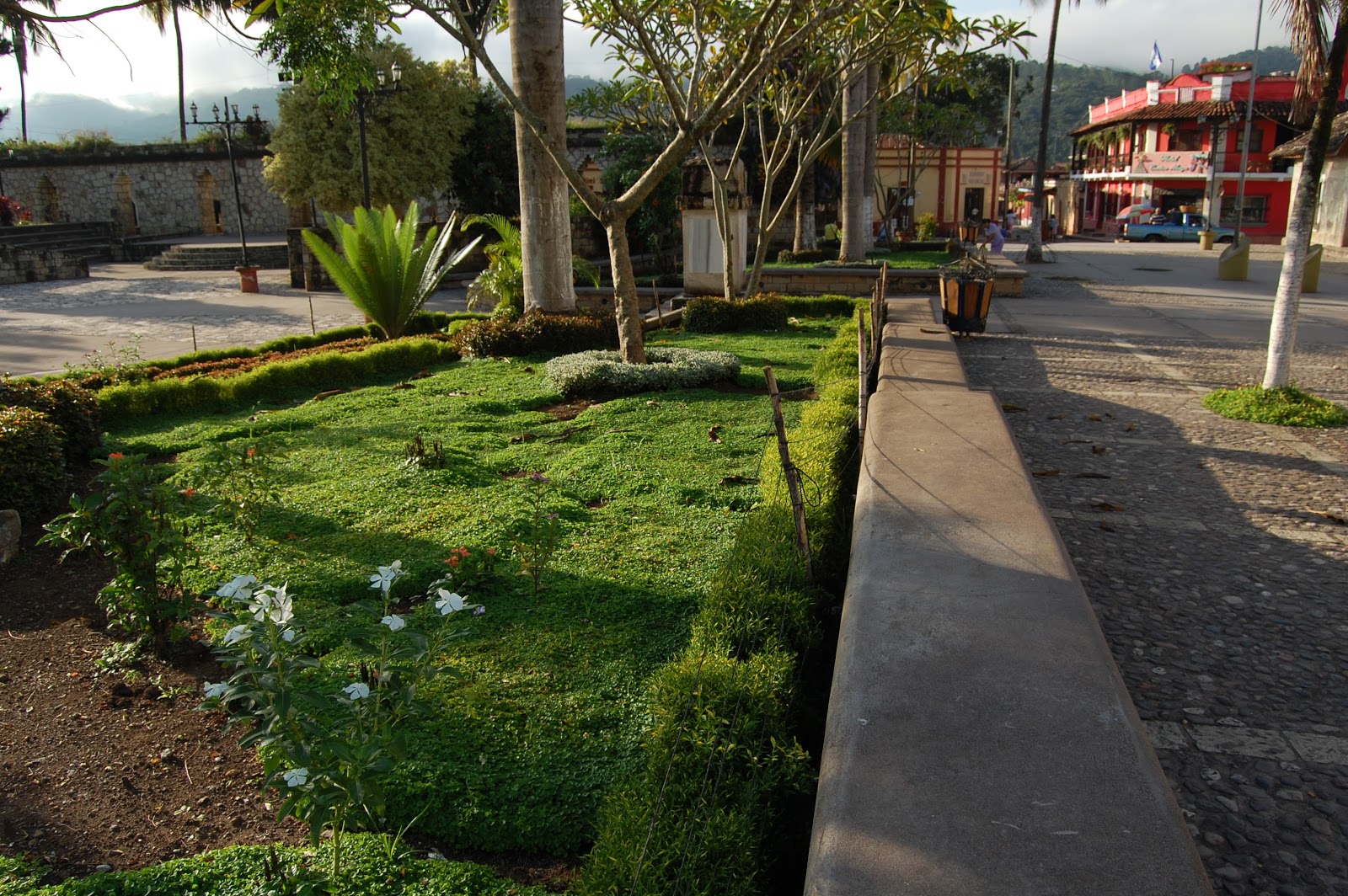
The small town is located in the mountainous northwest of Honduras some ten miles from the border with Guatemala.  The town is built around a beautiful central plaza bordered by a large church, municipal buildings, shop and hotels.  The Spanish influence is obvious in the architecture, but the flavor is Honduran.  There is a predominant Mayan population, with storefront signage in both Spanish and sometimes Mayan.   The clean, narrow streets are cobbled with large stones and bordered with narrow sidewalks.  Situated on a hillside, the only flat area is near the central Plaza.  Most residents walk but there are lots of three wheeled taxies scurrying along the one-way streets. 

Church on the Central Plaza
Early morning on the Plaza

Tourism plays a major economic role in Copán.   One of the finest areas of Mayan ruins is located less than a mile from the Plaza.  The ruins are beautiful and half-day tour and exploration should never be missed.  A visit to Macaw Mountain is also a good idea.  The Copán’s narrow streets are full, but not crowded with, local people selling crafts and local food.  Hand made jewelry of jade and other semiprecious stones; weavings, embroidery, stone carvings and leather goods fill tables centered near the plaza.  I felt little pressure to buy, and browsing is encouraged.   There are restaurants to suit any taste and price, from gourmet to tipico.  We stayed in a small hotel just off the Plaza.  It was clean and comfortable. 

Mayan Traditional Garb on Sundays for Church
Coffee shops open at 6AM as the town awakens to people walking to their jobs, or compesinos waiting to catch a ride to the coffee plantations.  Everyone offers “Buenos Dias”, or just “Buenos….”. 

The Conference was held at the Clarion Hotel just outside town near the ruins.  An impressive facility, many attendees stayed there.    There were speakers on many topics dealing with everything from educational issues, healthcare, security and orphanages, to economic resources, and entrepreneurism to government assistance for volunteerism.

 The U.S. Ambassador to Honduras spoke, as did representatives of the U.N., USAID,  and the Honduras Congress.  There were speakers from many NGOs, mission groups, and other entities, secular and non-secular.    Most participants represented concerns in the central area of the country.  There was little representation from Colón and even less from Gracias a Dios except by the AHMEN cadre.  AHMEN had the largest presence of any group attending and we made our presence known.


Francisco Morazán
Presentations were limited to 15 minutes and were grouped by subject matter as in healthcare, education etc.  There Q&A sessions after the completion of each sector.  Presentations were delivered in either English or Spanish with real-time translation via radio earpieces.  Computer projectors displayed PowerPoints to the room and to the overflow in a separate dining room nearby.  The quality of the presentation was excellent.  A large component of the meeting, and it’s stated goal and purpose, was to encourage networking between the attendees.  Plenty of break time and meet-and- greets were encouraged.   Socializing was encouraged and these times were used for networking and making contacts with people with similar interests.


I found the Conference on Honduras to be extremely valuable.  The AHMEN team all felt that an increased presence next year is indicated.  I would invite anyone interested to contact me about the 2012 Conference to be held in October.

After Dark in Copán Ruinas


Marimba Band at the Conference


Wednesday, July 6, 2011

Safer AHMEN Medical Clinics

The patient and family wait patiently and finally see the doctor.  An illness may be diagnosed and appropriate medication is prescribed.  The patient, and her trailing children walk to the AHMEN pharmacy and the doctor’s prescription is filled for the patient.  In addition to the therapeutic medication given, it is likely that the family will be given vitamins for each member and maybe an anti-parasite medication.  We give out lots of vitamins.  I wonder the patients think there is some magical power associated with vitamins?  The kids sure like them though.

So we hand the mother a labeled plastic zip-top baggie full of vitamins for each child.   We carefully admonish the parent and the child about dosage.  “Only one tablet each day!  These are medicine, not candy”.  Off goes the family to their home and we feel good about our successful thwarting of malnutrition. 


Each AHMEN medical mission team spends a lot of money on vitamins.  They are not cheap regardless of the source.  We purchase large quantities for adults, children and pregnant women.  We usually try to buy vitamins containing iron, as most brands do.  Children’s vitamins are almost always tasty morsels, chewy, sweet and shaped like characters that the kids in Honduras have never seen.  What the kids see is a baggie of somewhat sour, but still yummy candy.  More than a few times I have seen a child eating their month or two’s supply of vitamins like it was a bag of M&Ms.  Did we not make it clear enough that this is ”medicine”?  What could we have said differently?  Was our translation of instructions accurate?  Or, are they just kids that like all others and can't resist sweet treats.

Vitamins are not candy.  We adults know that.   In the U.S., they are a mega business catering to both parents and the kids.  Flintstones, Gummies, every Saturday cartoon hero has a “one-a-day” image of themselves sitting on the shelf at Walmart.  Specifically, the problem with vitamins is their iron content.  Iron is toxic when taken to excess.  Difficult to treat in the U.S., severe iron poisoning in Honduras is likely to be lethal to a child.  Vitamins are not the only problem.  What if a child gets hold of some blood pressure medicine or some diabetes medicine?  The odds of a child surviving an overdose of grandma’s diabetes pills are not good.


We hand out thousands of pills in ways that can endanger people on every medical mission trip.  To my knowledge, we have had no medication related problems as a result of an AHMEN mission.  We do hear stories about children dying yearly as a result of American medical mission team.  Urban legend?  More importantly, what can we do about it?  How can we lessen the risk of harming the people we work so hard to help?

In the U.S. there are regulations that pharmacies must adhere to concerning packaging, labeling and patient instructions for every prescription they fill.  I think it is time for us to try to emulate their good points.

The first change I propose is the use of child resistant containers wherever possible.  The plastic bags we use now for medications cast a few cents each.  Using plastic pill bottles with “C/R” caps would cost about 18-50 cents per prescription, depending on the size of the bottle.  The label on each bag/bottle cost another 2-3 cents.  These seem like small amounts, but filling several hundred scripts each day can get expensive.  I anticipate that using safe packaging will add $200-$300 to the cost of medication and supplies for most missions.  The shear volume of the bottles will require extra baggage. 

Those working in the pharmacy must realize that their job is extremely important.  They must fill each prescription accurately and they must be sure that the patient or caregiver completely understands how the medication is to be taken.  The pharmacy is the busiest place at the clinic.  It is the place where bottlenecks occur and where mistakes are most likely to occur.  We must spend extra time training those serving amidst the hundreds of containers of pills.  There must be no language barriers in the pharmacy.

AHMEN will be sending a team to Honduras in August.  Child resistant packaging will be ordered for the clinics this week in hopes that our effort will make our medical mission work as safe as it is effective.  


Friday, June 3, 2011

Honduras: My Future in My First Centimeters

I received this link from Project Honduras.  It is a World Bank production on YouTube.com.  Granted, I am not a great fan of the World Bank but the video was interesting.  The apparent goal of the video, is to describe a simple way to measure the nutritional health of children.  World wide, a child should be about 80 cm tall by the time they are two years old. This number is independent of where in the world the child lives  Less than that is an indicator of poor nutrition.  It is a simple way for the parents and health care providers to know the progress of their growing children.  The video is in both Spanish and English, and is directly directed at a Honduran audience.

My thoughts were to put this video on a CD and run it in the waiting area for your next clinic in Honduras.  Most teams bring a laptop with us.  What better way to fill the waiting time to see the doctor than to teach.  

Watch the video.  If you know how to download and capture a YouTube, video than do so and bring it with you on your next mission.  If you can't do this, email me telling me the video format you need and I will mail you a copy on a CD or DVD.


Links In English and Spanish :